

Complex and rescue cases
Bone grafting for implants, in plain language
Grafting rebuilds bone that's been lost, so implants have something strong to hold on to. Here's how it works.
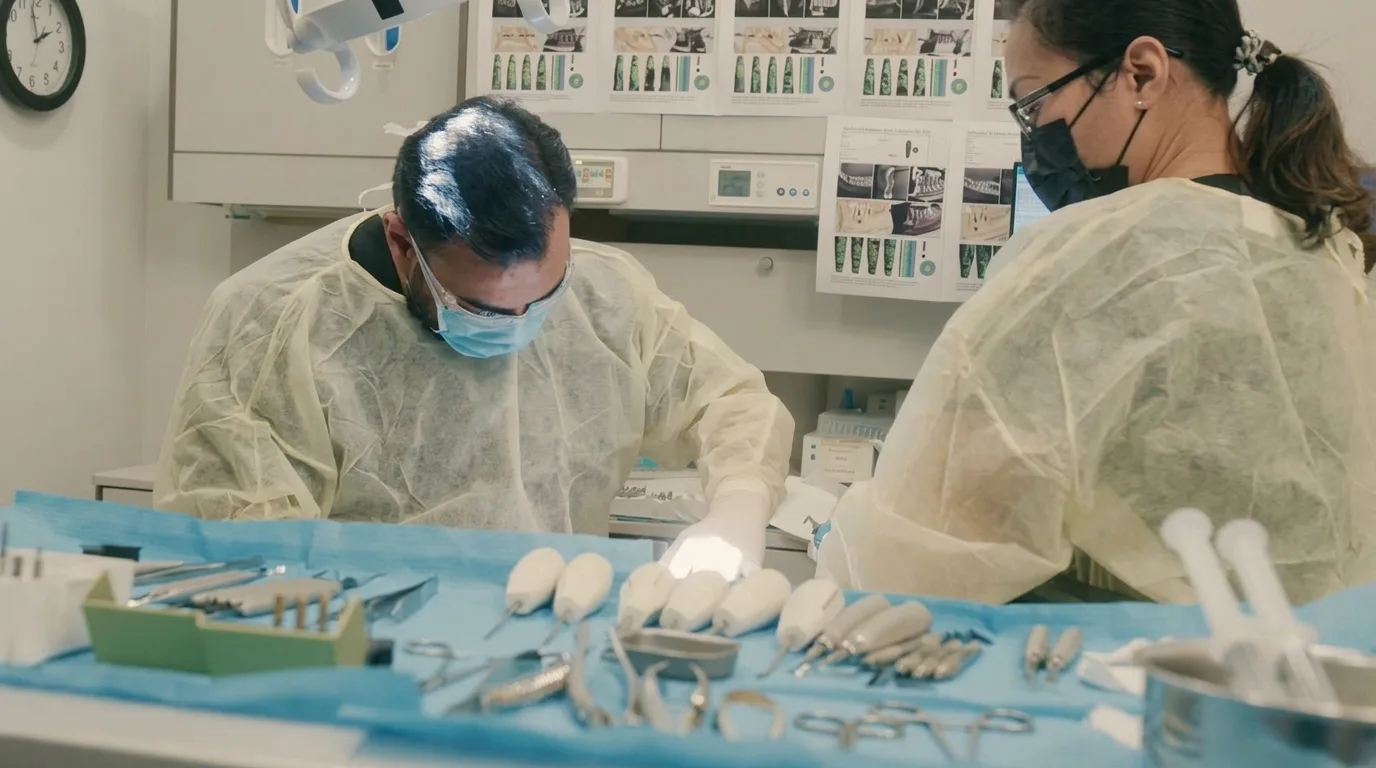
An implant needs enough bone around it, in height and width, to be stable and to look natural. When bone has been lost, grafting rebuilds it.
What the graft is made of
- Your own bone (autograft), usually taken from nearby in the jaw; it heals well but needs a second site
- Donor bone (allograft), processed and sterilised human bone from a tissue bank
- Animal-derived bone (xenograft), usually bovine; it keeps its shape for a long time
- Synthetic materials
The graft acts as a scaffold: over months, your body grows new bone into it and replaces it. Often a combination is used, and PRF (platelet-rich fibrin, made from a small sample of your own blood) can be added to support healing.
Common kinds of grafting
Socket preservation
Graft placed into the socket right after a tooth is removed, so the bone doesn't collapse while it heals.
Guided bone regeneration (GBR)
Graft placed where bone is missing and covered with a membrane that keeps gum tissue out while new bone forms. It's the most common way to build up width or height.
Ridge split (ridge expansion)
When the jaw is tall enough but too narrow, it can be carefully split and widened, and the implant placed into the space, often with graft alongside it.
Sinus lift
Graft placed beneath the sinus floor in the upper back jaw.
Block grafts
For larger defects, a block of bone is fixed in place with small screws.
How long it takes
Small grafts done with the implant add little or no time. Larger grafts usually need four to nine months before implants are placed or loaded. Dr. Ali Mehdi will tell you the expected timeline before you decide.
Dr. Ali Mehdi teaches these techniques to other dentists: his courses on guided bone regeneration and alveolar ridge split are on ImpactED.
Questions
Will my body reject the graft?
Graft materials are processed to be biocompatible and rejection is very rare. Infection is the main risk, which is why careful technique and aftercare matter.
Is grafting always needed?
No. Tilted, short or zygomatic implants can sometimes avoid it. Your scan shows which approach makes sense.
Keep reading
Related questions
- 01Not enough bone for implants?Grafting, sinus lift, tilted and zygomatic implants
- 02Sinus lift before implantsWhat it is, when it's needed, how long healing takes
- 03Failed dental implantsWhy implants fail, warning signs, and what can be done
- 04Zygomatic implants in BCWhen the upper jaw has too little bone for regular implants
Find out what's possible for you
A consultation with Dr. Ali Mehdi starts with your scans and your goals, and ends with a clear plan you understand.