

For dentists · Clinical guide
Reading CBCT for implant planning: landmarks and common mistakes
A CBCT is only as useful as the reading of it. These are the structures and pitfalls that matter most.
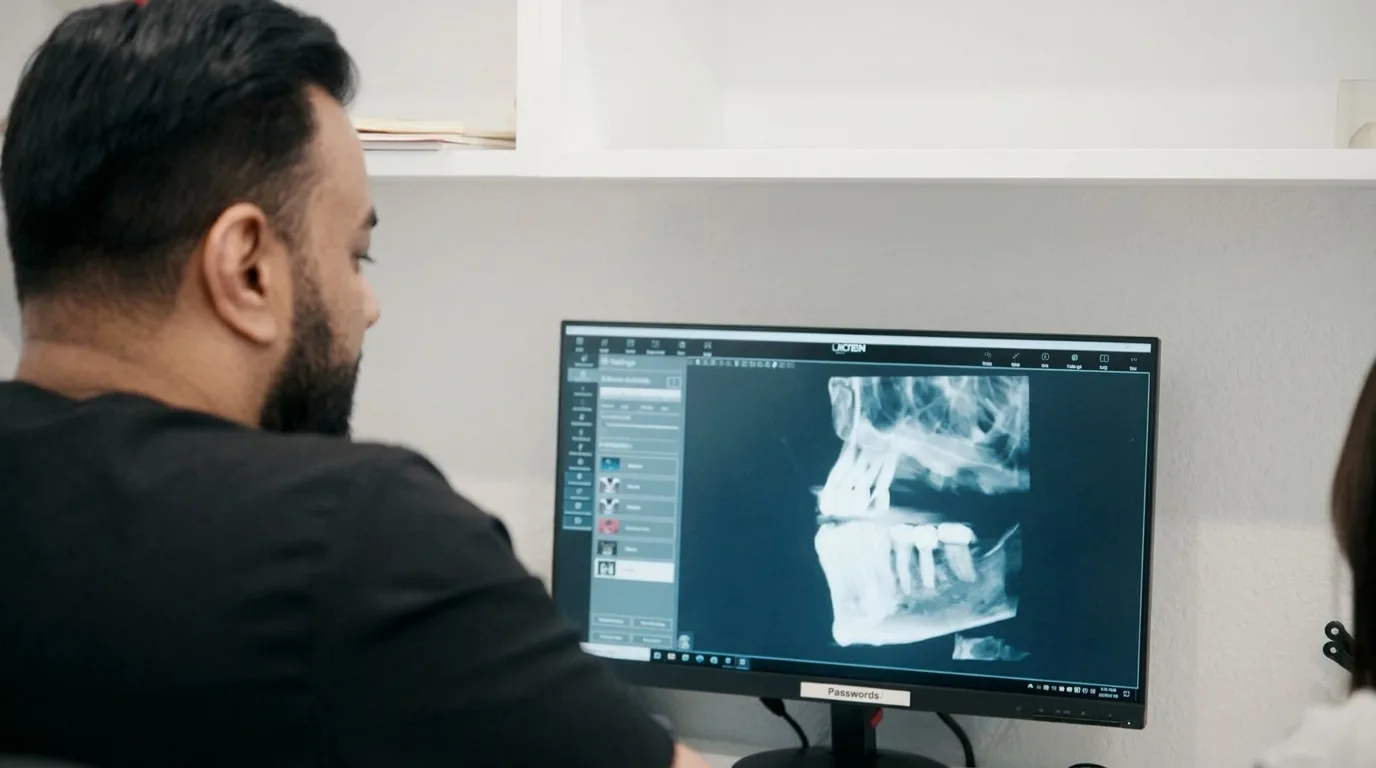
Before you read
- Scan with the patient's mouth slightly open or with cotton rolls, so the arches don't overlap
- Use a field of view that includes the whole region and any relevant anatomy (the sinus, the mandibular canal)
- Reorient the volume so the occlusal plane is level and cross-sections are perpendicular to the ridge
- Read the whole volume, not just the implant site: incidental findings are your responsibility
Mandible
- Inferior alveolar canal: trace it in panoramic and cross-sectional views; keep a safety margin of at least 2 mm
- Mental foramen and anterior loop: the loop can extend several millimetres forward of the foramen
- Lingual concavity in the posterior mandible: perforation risks bleeding in the floor of the mouth
- Lingual foramina and canals in the anterior mandible
Maxilla
- Sinus floor, septa, membrane thickening and signs of sinusitis
- Nasal floor and the nasopalatine (incisive) canal
- Buccal plate thickness in the aesthetic zone
- For zygomatic planning: the zygoma, orbit and infratemporal fossa
Bone quality
Grey values in CBCT are not true Hounsfield units and aren't reliable for measuring density. Judge bone quality clinically and from the cortical thickness and trabecular pattern, not from numbers.
Common mistakes
- Measuring on the panoramic reconstruction alone, which distorts
- Cross-sections not perpendicular to the ridge, which overestimates width
- Missing the anterior loop or a bifid canal
- Ignoring artefacts from metal restorations
- Planning bone, not teeth: always plan from the restoration
- Not reading outside the area of interest
Dr. Ali Mehdi's course Unlock Implant Radiology on ImpactED covers imaging, landmarks and interpretation in depth.
Keep reading
Related guides
A complex case on your schedule?
Send the records. Dr. Ali Mehdi reviews them and you stay part of your patient's care from start to finish.